

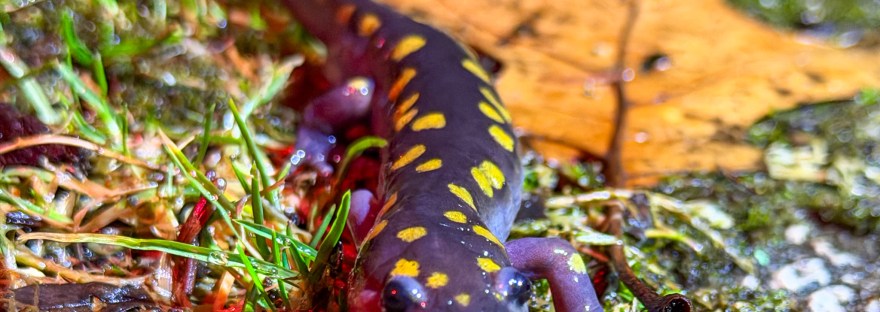
Picture this: it’s a dark, rainy spring night in Brecksville Reservation. You’re standing on a quiet stretch of road with a flashlight in one hand and rain slowly working its way down the back of your collar. You’re wet. You’re questioning your life choices. The woods are silent except for dripping leaves and the occasional distant peeper frog.
Then your flashlight beam catches something… A tiny shape moving across the pavement.
You step closer and there it is — a spotted salamander, glossy black with bright yellow spots, gleaming in the rain like a little living constellation.
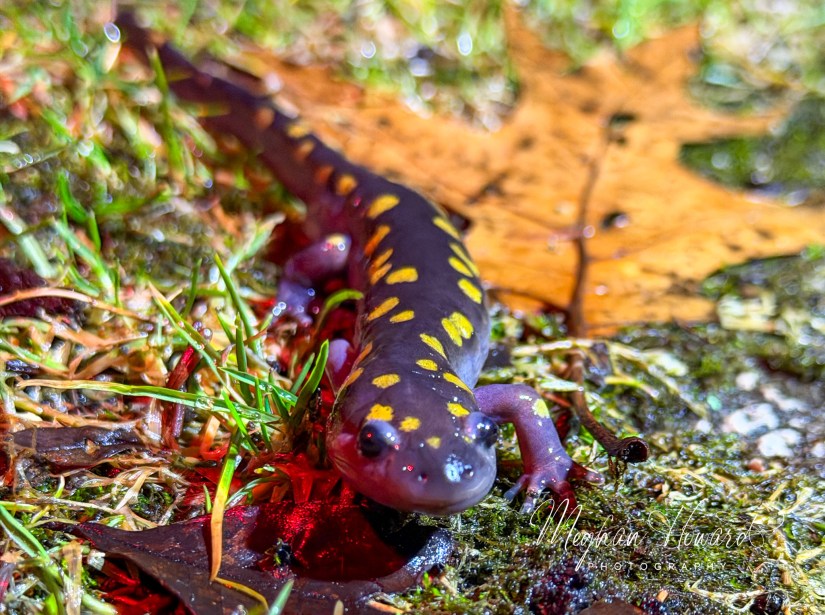
Behold! You’ve just stumbled into one of Ohio’s most secretive wildlife spectacles, and it only happens once a year.
I witnessed the great salamander breeding trek this spring and I’m still not fully over it. Nerd achievement unlocked? Absolutely. This is the kind of thing that reminds you how wildly magical Ohio actually is when you know where to look — even if that means standing in the rain like a soggy woodland goblin at 9:30 p.m.
When to Go
Timing is everything with this one. The salamander migration usually happens during the first warm, heavy rains of spring, typically around mid-March. Some years it kicks off in late February. Other years it drags into early April. Salamanders are many things, but punctual is not one of them.
The magic combination you’re looking for:
• Temperatures above 40°F
• Steady rain or very wet ground
• After sunset
Why rain? Salamanders breathe partly through their skin, which means they must stay moist. On dry nights they stay underground. On rainy nights they emerge by the hundreds like tiny amphibian commuters headed to the world’s most important pool party. Activity usually peaks about an hour after dusk and can continue for several hours.
Your best move is to watch the weather and keep an eye on the Cleveland Metroparks social media pages. When the first warm rainy stretch appears in the forecast, that’s your cue. Cancel your evening plans. The salamanders have somewhere to be.
What’s Actually Happening Out There
Beneath the forest floor, something ancient is waking up.
All winter long, salamanders have been brumating underground — sometimes several feet down in burrows or tucked beneath roots and rocks. When temperatures rise and the ground becomes saturated with rain, a signal flips.
It’s time. Hundreds of salamanders emerge from the forest floor and begin migrating toward something called a vernal pool. Vernal pools are temporary woodland ponds formed by snowmelt and spring rain. They’re usually shallow, tucked into the forest, and completely dry up by summer.
That disappearing act is actually the entire point. Because the pools dry up every year, fish can’t survive in them. No fish means no fish predators. And no fish predators means amphibian babies get a safe place to grow.
So for a few short weeks each spring, these quiet little puddles become the most important real estate in the forest. The salamanders gather here to mate and deposit gelatinous egg masses attached to submerged sticks and leaves. Then, just as quietly as they arrived, they disappear back into the woods.
Many will spend the rest of the year hidden underground within a few hundred feet of that same pool. And next spring? They’ll do it all over again.
Some spotted salamanders can live more than 20 years, returning to the exact same pool their entire lives. Which means the salamander crossing the road tonight might have been making this same commute since before your favorite hiking boots existed.
How to See It (and Where to Go)
Head to Brecksville Reservation in the Cleveland Metroparks.
The most reliable viewing area is along Valley Parkway between Brecksville Road and Meadow Road, near Deer Lick Cave.
Enter from Brecksville Road (Route 21) and drive east down Valley Parkway toward Deer Lick Cave. After about a mile you’ll reach a section of road that is often closed to vehicle traffic during migration events. Park safely along the shoulder and continue on foot.
From there, walk east roughly a quarter to half mile around the Deer Lick Cave area. You’ll find salamanders both crossing the road and gathering in the shallow woods near vernal pools on either side. Spend time near the pools if you can. That’s where the real amphibian social hour is happening.
Pro tip for avoiding crowds: the Deer Lick Cave Trail runs north and east from the same area and winds through prime vernal pool habitat. It will be muddy, wet, and full of salamanders — which is exactly what you want.
What to Bring
- A flashlight or headlamp with at least 1,000 lumens. Your phone flashlight is not adequate for amphibian detective work.
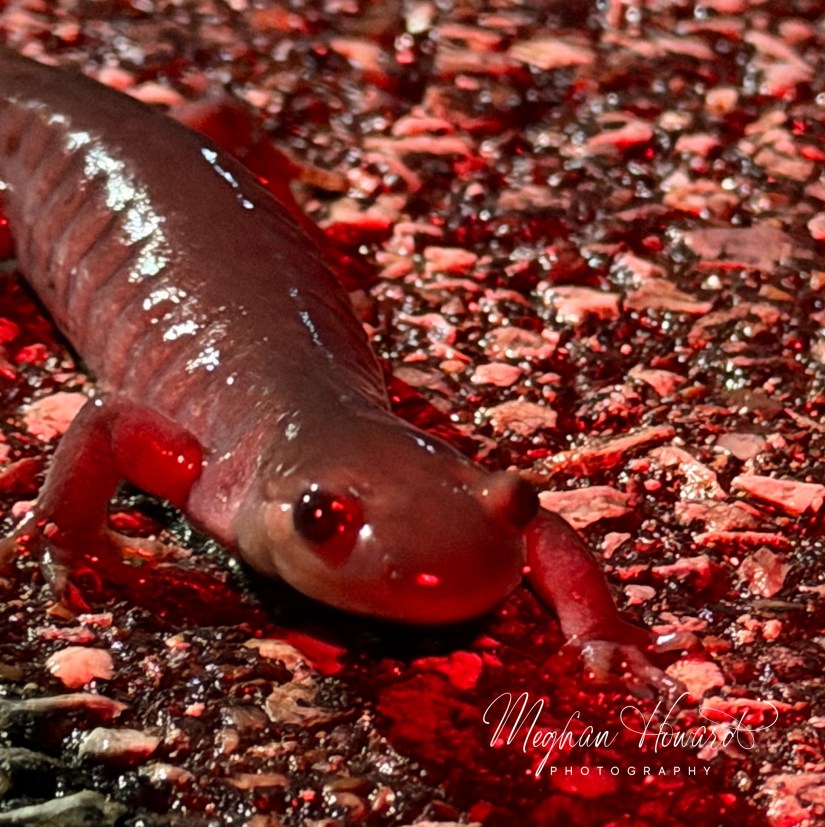
- A red filter or red-light setting to reduce disturbance to the animals.
- Waterproof boots. The forest will absolutely try to eat your socks.
- Warm rain-appropriate layers. Early spring nights in Ohio are aggressively chilly.
- And most importantly: walk slowly and watch your step. Salamanders are small, dark, and extremely easy to accidentally step on.
- Plan to spend at least an hour exploring.
- Leave dogs at home, avoid handling wildlife, and give the salamanders plenty of space while they go about their very important amphibian business.
Who You Might Meet
Brecksville’s vernal pools host a surprisingly impressive amphibian cast:
- Spotted Salamander — the star of the show, black with bright yellow spots like someone spilled starlight on it
- Jefferson Salamander — a more subtle gray-brown species that looks a bit like the mysterious cousin at the family reunion
- Red-Backed Salamander — small but extremely common forest residents
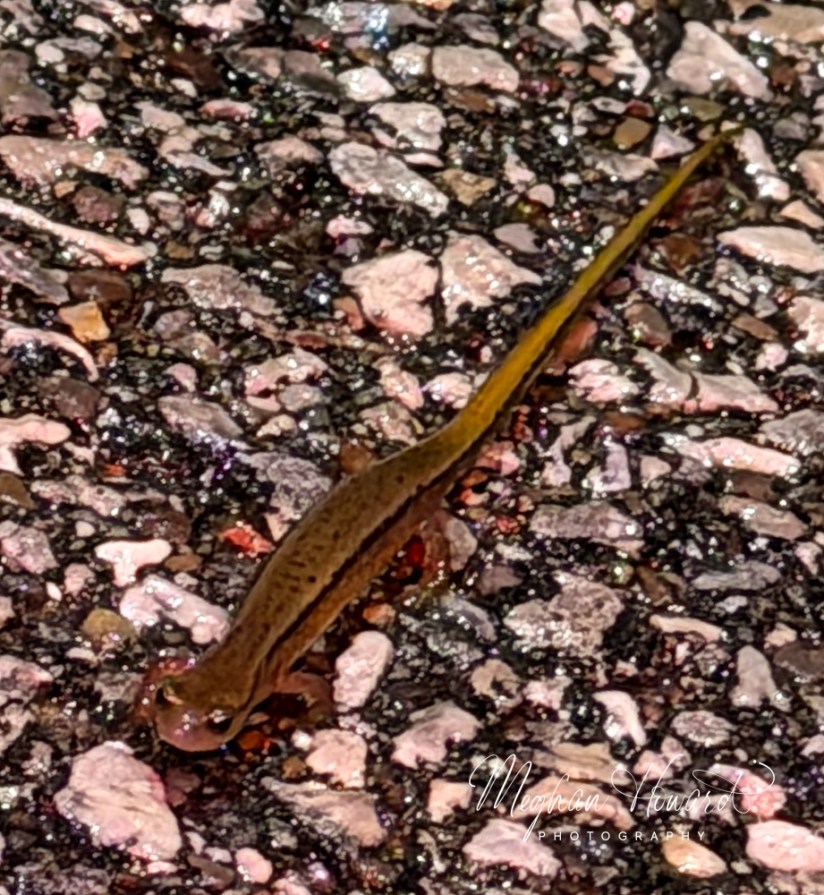
- Northern Two-Lined Salamander
- Eastern Newt — whose bright orange juvenile stage, called a red eft, wanders the forest floor like a tiny Halloween decoration
- And hovering over everything is the sound of spring peeper frogs calling from the darkness. That high-pitched chorus is basically the official soundtrack of early spring in Ohio.
Salamander Nerd Facts
Spotted salamanders can live more than 20 years.
They breathe through their skin, which is why moisture is non-negotiable and why handling them can harm them.
Their egg masses contain a green algae that actually lives inside the eggs, producing oxygen for the developing embryos. It’s one of the only known vertebrate-algae symbioses on Earth, which is extremely cool if you enjoy weird biology facts.
Hundreds of salamanders can migrate through this area over the course of a couple rainy nights.
Which means somewhere in the woods right now, hundreds of tiny amphibians are quietly completing a mission that has been happening for thousands of years. No audience required.
Go. Seriously. Just Go.
The salamander migration sounds niche until you’re standing in the rain watching a spotted salamander confidently waddle through a puddle like it owns the entire forest. And honestly? For a few minutes, it kind of does. There’s something deeply grounding about witnessing a ritual that has nothing to do with humans — something ancient, quiet, and persistent happening in the woods just twenty minutes outside Cleveland. Ohio’s wild places are full of moments like this. You just have to show up on a rainy night and look.
Have you seen the salamander migration? Drop a comment below — I want to hear about it.

 She is Wild & Free